Zoho CRM vs Zoho ERP: 5 Essential Differences (Best Guide)

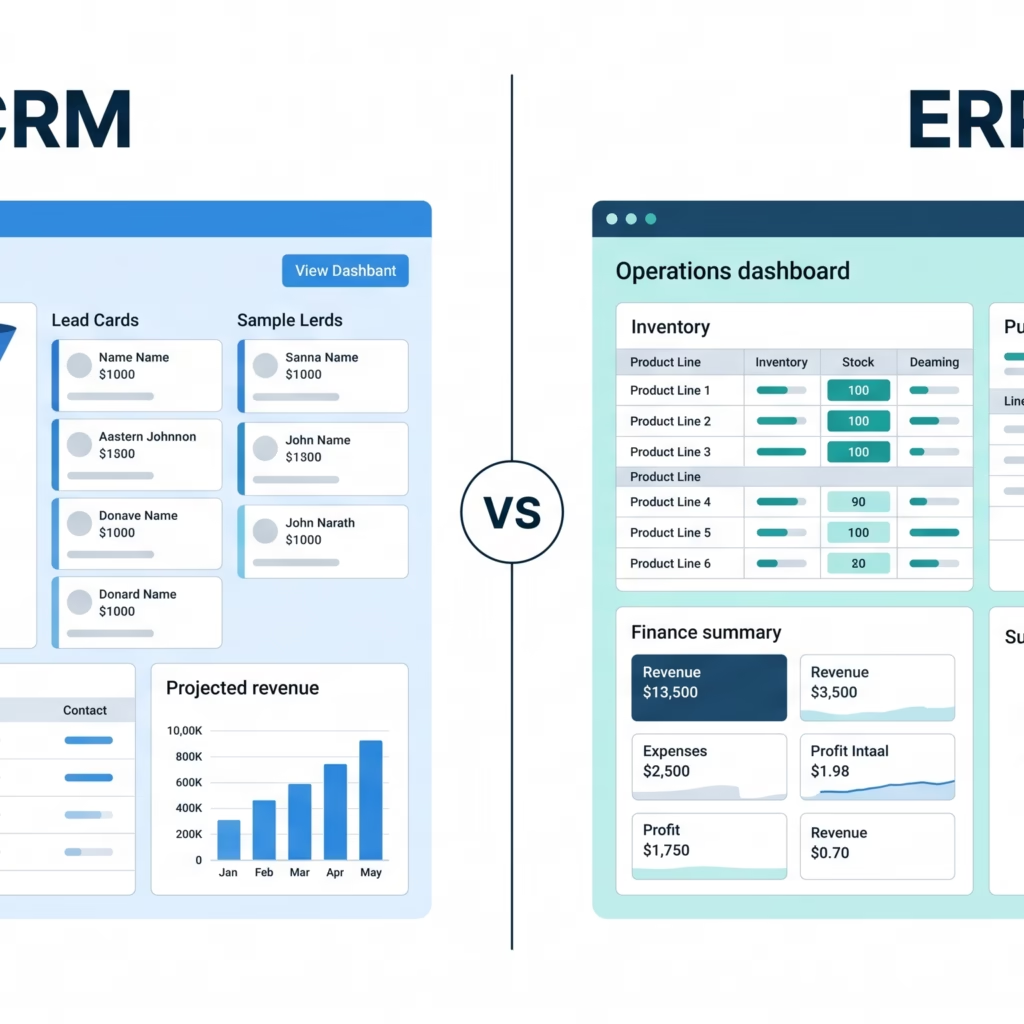
Two Zoho products. Two entirely different jobs. The debate around Zoho CRM vs Zoho ERP comes up constantly among Indian SMBs — and understandably so.
Both carry the Zoho brand, both handle business data, and both appear in the same vendor conversation. But they operate in fundamentally different parts of your business, serve different teams, and solve different problems.
Choosing the wrong one means investing in a solution to a problem you do not currently have — while the actual problem gets worse.
This is not a which-is-better debate. Both products are built well. This is a decision guide: by the end, you will know which product your business needs right now, and when running both starts to make sense.
Table of Contents
What Is Zoho CRM? (The Revenue Engine)
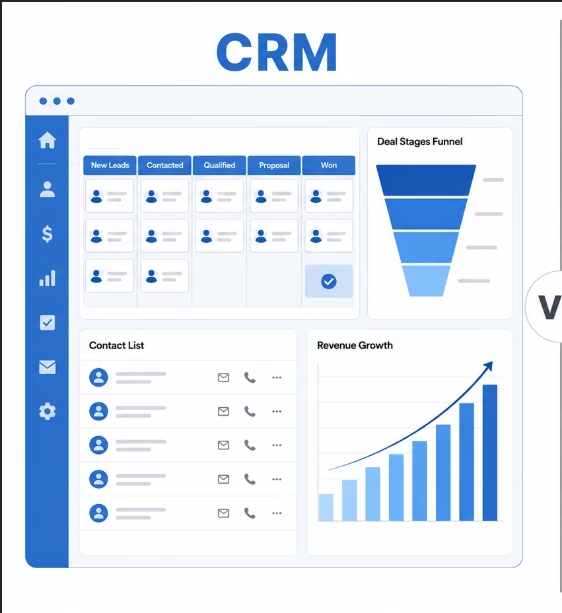
Zoho CRM is a sales-focused customer relationship management platform that has been in market since 2005. More than 300,000 businesses worldwide use it to manage leads, deals, and customer communication across every stage of the sales lifecycle.
Its core job: help your sales team win more deals and retain the customers they have already won. Every feature — from pipeline views to AI-assisted email rewriting — exists in service of that goal.
- Pipeline management — track every deal from first contact to closed-won, with full activity history
- Omnichannel engagement — email, phone, live chat, social media, and WhatsApp in one unified inbox
- Workflow automation — trigger follow-ups, task assignments, and alerts without manual input
- Sales forecasting — predict revenue at territory, team, or rep level using configurable models
- Custom modules — extend CRM to match your specific sales or account management process
- CRM for Everyone — shared team spaces and collaborative modules that give non-sales departments a view into the customer
The AI layer is called Zia. It handles anomaly detection in your pipeline data, lead scoring, email sentiment analysis, intelligent email rewriting, and agentic AI tasks — where the system takes action based on context rather than waiting for manual input.
Gartner recognised Zoho CRM as a 2025 Magic Quadrant Visionary for Sales Force Automation — a placement that reflects product depth and R&D investment, not just installed base size.
Zoho CRM is not built to manage inventory, run payroll, or track GST filings. It is built to grow revenue. That is its design philosophy.
What Is Zoho ERP? (The Operations Backbone)
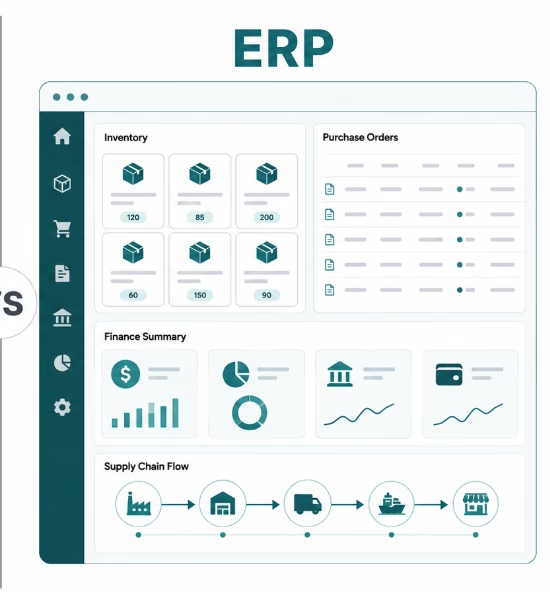
Zoho ERP launched in January 2026 and is currently available in India only. It consolidates finance, supply chain, inventory, HR, payroll, and billing into a single unified platform — replacing the need to manage separate tools that do not talk to each other.
Where CRM faces outward — toward customers and revenue — ERP faces inward, toward the operational machinery that delivers on the promises your sales team makes.
- Core Financials — GST-compliant accounting, e-invoicing, e-Way bill generation, and banking integration
- Supply Chain Management — procurement, vendor management, purchase orders, and inbound logistics
- Omnichannel Commerce — unified order management across sales channels and locations
- Billing Management — subscription billing, revenue recognition, and invoice tracking
- People Management — HR records, leave management, attendance, and employee lifecycle
- Payroll — India-compliant salary processing with statutory deductions (PF, ESI, PT, TDS)
Zoho ERP is built on proven Zoho applications: Zoho Books handles financials, Zoho Inventory manages stock, Zoho People covers HR, and Zoho Payroll processes salaries. The ERP layer unifies these into one consolidated system with shared data — rather than Zoho One’s approach, where you subscribe to individual apps and connect them yourself.
Target industries: Manufacturing, Distribution, Retail, and Non-profits. These are businesses where operational complexity — multi-location inventory, supplier networks, statutory compliance — has become the main constraint on growth.
Zoho ERP is not built to manage your sales pipeline, track deals, or run marketing campaigns. It is built to make sure the business runs correctly once the sale is made.
[IMAGE: Zoho ERP modules overview — finance, HR, supply chain, payroll | alt=”zoho crm vsoho erp — zoho erp modules covering finance, supply chain, HR, and payroll for Indian businesses”]
Zoho CRM vs Zoho ERP: Feature-by-Feature Comparison
Core function
Zoho CRM’s core function is managing the customer relationship — from the first marketing touchpoint through to post-sale retention. The fundamental unit of work is a deal or a contact.
Zoho ERP’s core function is managing internal operations — procurement, production, finance, compliance, and people. The fundamental unit of work is a transaction, a purchase order, or a payroll run.
They do not compete. They cover different phases of the same business.
Who uses it daily
CRM is used daily by sales representatives, account managers, marketing teams, and customer success staff — anyone whose output is measured in revenue or customer outcomes.
ERP is used daily by finance teams, operations managers, HR staff, supply chain coordinators, and warehouse managers — anyone whose output is measured in process efficiency, compliance, or operational accuracy.
Key modules
CRM: Leads, Contacts, Accounts, Deals, Activities, Email campaigns, Sales Forecasting, Workflow automation, Custom modules, CRM for Everyone team spaces.
ERP: Core Financials (GST, e-invoicing, e-Way bill), Supply Chain Management, Omnichannel Commerce, Billing Management, People Management, India-compliant Payroll.
AI capabilities
CRM: Zia is the AI layer — purpose-built for sales intelligence. It detects pipeline anomalies, scores leads, analyses email sentiment, rewrites emails, and supports agentic AI workflows. Zia has been part of CRM since 2017 and is a production-grade feature, not a preview.
ERP: AI capabilities are embedded within the underlying Zoho apps — Books AI for financial anomalies, Inventory AI for demand forecasting. ERP-specific AI orchestration is still maturing; the product launched in January 2026, so expect this area to evolve through the year.
Pricing (India)
Zoho CRM:
- Free — up to 3 users
- Standard — $14/user/month
- Professional — $23/user/month
- Enterprise — $40/user/month
- Ultimate — $52/user/month
All plans billed annually.
Zoho ERP:
- ₹2,499 per user/month (premium plan)
- ₹249 per employee/month
- 14-day free trial available
Availability
CRM: Global — available in all major markets, priced in USD, localised across regions.
ERP: India only as of January 2026. International availability has not been announced. If your business operates outside India or plans to expand internationally, this is a significant constraint to evaluate before committing.
Comparison Table
| Feature | Zoho CRM | Zoho ERP |
|---|---|---|
| Primary purpose | Sales & customer relationships | Operations, finance & people |
| Core users | Sales, marketing, customer success | Finance, HR, operations, supply chain |
| AI assistant | Zia (mature, production-ready) | Embedded AI (maturing) |
| GST / compliance | Not applicable | Built-in e-invoicing & e-Way bill |
| Payroll | Not included | India-compliant payroll |
| Entry price (India) | Free (3 users) | ₹2,499/user/month |
| India availability | Yes (global product) | Yes (India only, Jan 2026) |
| Free trial | Yes | 14-day trial |
| Built on | Dedicated CRM platform (since 2005) | Zoho Books, Inventory, People, Payroll, Creator |
| Gartner recognition | 2025 MQ Visionary (SFA) | Not yet rated |
When to Choose Zoho CRM
Choose Zoho CRM when your primary growth constraint is on the revenue side. These are the specific signals:
Leads are falling through the cracks. If prospects go cold because no one followed up, or deals stall because there is no pipeline visibility, you have a CRM problem — not a headcount problem.
Your sales team works reactively. No forecasting, no structured pipeline, no automated reminders. CRM gives your process the structure it needs to scale beyond a handful of people.
You are growing your sales headcount. Moving from two salespeople to ten without a CRM creates chaos. You need a system where every rep’s activity is visible, assigned, and tracked — not a shared inbox and a spreadsheet.
Marketing and sales are misaligned. CRM for Everyone gives marketing, support, and operations a shared view of the customer. That visibility eliminates the classic failure mode of sales promising what operations cannot deliver.
You operate internationally or plan to. CRM is a global product available in all markets. ERP is not — if international expansion is on your roadmap, CRM is the safe choice while ERP’s global rollout matures.
You need AI-assisted selling today. Zia’s lead scoring, anomaly detection, and agentic capabilities are production-grade features — not roadmap items.
For organisations already running Zoho CRM that want to layer analytics on top of their pipeline data, our guide on Zoho CRM and analytics integration covers how to connect CRM to Zoho Analytics for smarter revenue decisions.
When to Choose Zoho ERP
Choose Zoho ERP when your operational complexity has outgrown your current tools. These are the signals:
GST compliance is a manual burden. If your finance team reconciles GST filings manually, generates e-invoices outside your accounting system, or tracks e-Way bills separately, ERP consolidates this into one automated flow — designed specifically for India’s statutory requirements.
Your supply chain has no single source of truth. Procurement in one tool, inventory in another, vendor records in a third — this fragmentation costs time, creates reconciliation errors, and makes audits painful. ERP collapses these into one system.
HR and payroll are disconnected from operations. When headcount grows past 20 to 30 employees, manual payroll becomes a compliance risk. ERP’s India-compliant payroll handles PF, ESI, TDS, and PT as a core module — not an integration that breaks at quarter-end.
You are in manufacturing, distribution, or retail. Inventory movement, multi-location stock management, purchase order workflows, supplier management — these are core ERP functions with no CRM equivalent.
You are already running multiple Zoho apps separately. If you subscribe to Zoho Books, Zoho Inventory, and Zoho People independently, Zoho ERP consolidates them into one system with shared data and unified reporting. Fewer logins, fewer reconciliation points, one support relationship.
India-only note: Zoho ERP is currently available only in India. If your business already operates across international markets, this is a hard limitation. Evaluate Zoho One’s individual app approach as an interim strategy until ERP’s international rollout is confirmed.
Can You Use Both? (The Zoho One Angle)
Yes — and many growing Indian businesses will eventually reach the point where both are necessary, not optional.
CRM and ERP serve different departments with genuinely different data needs. CRM tells you what a customer bought, their deal history, and their likelihood of reordering. ERP tells you whether you can fulfil that order, at what margin, using which supplier, and whether payroll and compliance are current.
The natural integration point is the order handoff. When a deal closes in CRM, that order needs to move into ERP for procurement, fulfilment, invoicing, and delivery tracking. Without a clean handoff, your sales and operations teams are working from different versions of reality — a problem that compounds as you scale.
Zoho One offers a broader approach: 50+ Zoho apps under one license, including CRM and ERP-component apps (Books, Inventory, People, Payroll). The key difference between Zoho One and Zoho ERP is integration depth. ERP is a single unified system where data flows natively between modules. Zoho One is a collection of connected apps with varying degrees of native integration.
For businesses that want analytics across both CRM and ERP data, our overview of Zoho Analytics connector capabilities for 2026 covers how to build a unified reporting layer that pulls from both systems into one dashboard.
For official product documentation and trial access, Zoho ERP’s official product page has the most current information on modules, pricing, and onboarding requirements.
Final Verdict
Zoho CRM and Zoho ERP are not competitors. There is no meaningful confrontation in operational terms — they handle different phases of the business. The comparison matters only when you are deciding where to invest first.
Choose Zoho CRM if your priority is growing revenue, managing customers, and building a scalable sales process. It is globally available, free to start, and carries 20 years of product depth backed by Gartner recognition.
Choose Zoho ERP if your priority is operational control — GST compliance, supply chain visibility, and unified HR and payroll for an Indian business. It is India-focused, launched in 2026, and built for businesses that have outgrown fragmented tools.
Plan for both if you are a growing Indian SMB with genuine growth ambitions. The businesses that scale without operational chaos build the revenue engine and the operations backbone in parallel — not as an afterthought once things break.
The question was never which is better. The question is: which problem do you need to solve today?
Share this content:
This was a great comparison! Many people confuse Zoho CRM and Zoho ERP, so it’s helpful to see their different purposes explained so clearly. While Zoho CRM is focused on managing customer relationships and sales, ERP solutions handle broader business operations like finance, inventory, and procurement. Businesses planning to implement Zoho CRM can also benefit from working with a Zoho CRM implementation partner USA to customize the platform, streamline workflows, and ensure they get the most value from their investment. Thanks for putting together such an easy-to-understand guide!
Thank you.